
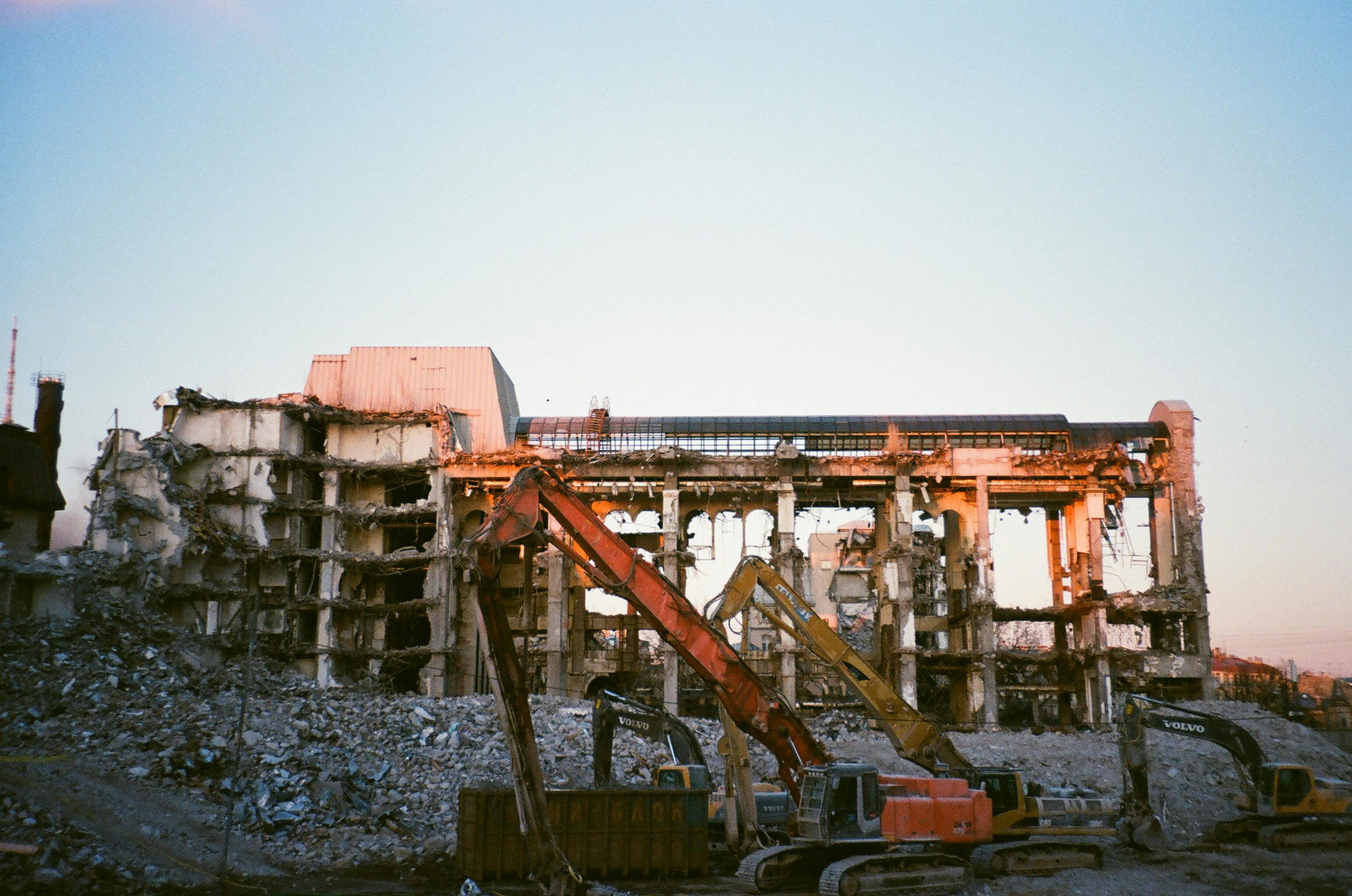
Most conversations about PM2.5 focus on ambient air, the kind measured at a regulatory monitor down the street. Over the past five years, one research team in Taiwan has kept looking somewhere else: the air at active construction sites, and what that particulate does to breast cancer cells in the lab. Their first study, published in 2021, sampled a building demolition site.[2] Their follow-up, published in 2026, sampled an earthwork and demolition project across a 24-month timeline.[1] Both started the same way, with a Tisch Environmental TE-6070 high-flow sampler in the field.[1][2]
Study One: Demolition Dust (2021)
Published in Chemosphere, the first study collected suspended particulate during the demolition of a four-story building, which ran from late December 2016 to mid-January 2017.[2] Samples were gathered with a Tisch Environmental TE-6070 high-flow sampler paired with a TE-231 high-volume cascade impactor.[2] Nearby PM2.5 concentrations rose significantly while the buildings were being taken down, and so did the levels of cadmium, copper, lead, zinc, and chromium in the water-soluble fraction.[2]
The researchers then exposed MDA-MB-231, a triple-negative breast cancer cell line, to that water-soluble PM2.5. Compared with the control group, exposed cells had a significantly higher survival rate and a greater capacity to migrate, along with increased activity in the FAK/PI3K/AKT signaling pathway.[2] The authors concluded that soluble demolition PM2.5 may increase the malignancy of these cells.[2]
Study Two: A Full Project Timeline (2026)
The follow-up, published in Journal of Hazardous Materials Advances, widened the lens. Instead of a single activity, the team sampled a residential earthwork and demolition site in the Chiayi area of Taiwan across four phases: foundation excavation, mud work, project completion, and an environmental background period after the work wrapped up.[1]
Jobsite PM2.5 ran well above what two nearby official monitoring stations recorded on the same days. It was roughly double the station readings during excavation and completion, and about 2.5 to 3 times higher during mud work.[1] Copper and zinc were the most abundant water-soluble metals, both peaking during mud work, with nickel and lead also elevated in that phase.[1]
In the lab, exposed breast cancer cells showed dose-dependent increases in migration and invasion. At the lowest concentration tested, invasive capacity roughly doubled compared with the control.[1] This time, the authors pointed to a different mechanism: autophagy, a process cells use to recycle their own components and adapt to stress, indicated by rising levels of the markers Beclin-1 and LC3-II.[1]
It's important to read both studies for what they are: cell-culture research, each from a single site. They show how this particulate behaved in a controlled lab model, not a measured health outcome in people. The 2026 authors note that their mechanism findings should be interpreted with caution until confirmed with additional testing, and that results could differ with other materials, weather conditions, and construction practices.[1]
The Common Thread: A Tisch Sampler at the Source
Five years apart, both studies began with the same instrument: a Tisch Environmental TE-6070 high-flow sampler, made in Cleves, Ohio, placed on an active jobsite.[1][2] In the 2021 study, the TE-6070 was paired with a TE-231 high-volume cascade impactor. Larger, heavier particles impact on filters in the early stages while smaller particles continue through, so the fine fraction can be collected on its own.[2] The 2026 paper cites the 2021 study when describing its sampling approach.[1]
The newer methods also show how the sampler was put to work. It was placed in an area workers frequently passed through, with its inlet set about 140 to 150 cm above the ground to match a worker's breathing zone. It ran around the clock at flow rates of 1.1 to 1.7 m³/min, collecting particulate on 8" × 10" quartz fiber filters.[1] In both studies, those filters were extracted for their water-soluble fraction and analyzed for metals with ICP-MS before any cell testing began.[1][2]
That's the part of research that rarely gets attention in the finished paper. Every finding in both studies traces back to particulate collected in the field, at the source, in enough quantity for a lab to analyze with confidence.
A Few Things Worth Knowing
Exposure shifts with the phase of work
Composition matters as much as concentration
Source-level sampling answers different questions
Side-by-Side: Two Studies
| Element | 2021 Study | 2026 Study |
|---|---|---|
| Published | Chemosphere, Volume 265[2] | Journal of Hazardous Materials Advances, Volume 23[1] |
| Sample source | Four-story building demolition, December 2016 to January 2017[2] | Residential earthwork and demolition site, sampled across four phases over 24 months[1] |
| Sampling equipment | TE-6070 high-flow sampler with a TE-231 high-volume cascade impactor[2] | TE-6070 high-flow sampler at worker breathing height[1] |
| Metals of note | Cd, Cu, Pb, Zn, and Cr rose during demolition[2] | Cu and Zn highest, peaking during mud work[1] |
| Test model | MDA-MB-231 breast cancer cells[2] | MDA-MB-231 breast cancer cells[1] |
| Observed effect | Higher cell survival and migration[2] | Dose-dependent increases in migration and invasion[1] |
| Proposed mechanism | FAK/PI3K/AKT signaling[2] | Autophagy activation (Beclin-1, LC3-II)[1] |
Why This Matters Beyond the Studies
Taken together, the two papers move from a single demolition event to a full construction timeline, with each one adding detail the other didn't have. The 2026 authors close with a practical recommendation: stronger exposure controls at construction sites, including engineering dust suppression, real-time air quality monitoring, and filtering facepiece respirators for workers.[1] They also call for future work using size-fractionated sampling to study ultrafine, metal-bound particles.[1]
Both recommendations point to the same need. Research like this depends on someone placing a sampler where the exposure actually happens rather than where it's most convenient to measure. That fieldwork is slower and less visible than the lab analysis that follows, but it determines whether the findings mean anything at all.
Key Takeaways
- Two studies from the same research team, published in 2021 and 2026, linked water-soluble construction PM2.5 to more aggressive breast cancer cell behavior in lab testing
- Both studies collected their samples on active jobsites with a Tisch Environmental TE-6070 high-flow sampler, paired with a TE-231 cascade impactor in 2021
- The 2026 study found jobsite PM2.5 about 2 to 3 times higher than nearby official monitors, peaking during mud work
- Metal content was a focus in both, with copper standing out across the two studies
- Both are single-site, cell-culture studies, so they point to a link worth further research rather than a measured health outcome
- The 2026 authors recommend dust suppression, real-time air quality monitoring, and respirators at construction sites
None of this is a reason for alarm on its own. It's a reason to keep asking what's actually in the air around active jobsites, and to keep collecting the data that can answer that question accurately.
The TE-6070 is used in both regulatory monitoring and research like these studies. Explore High Volume Air Samplers[4]